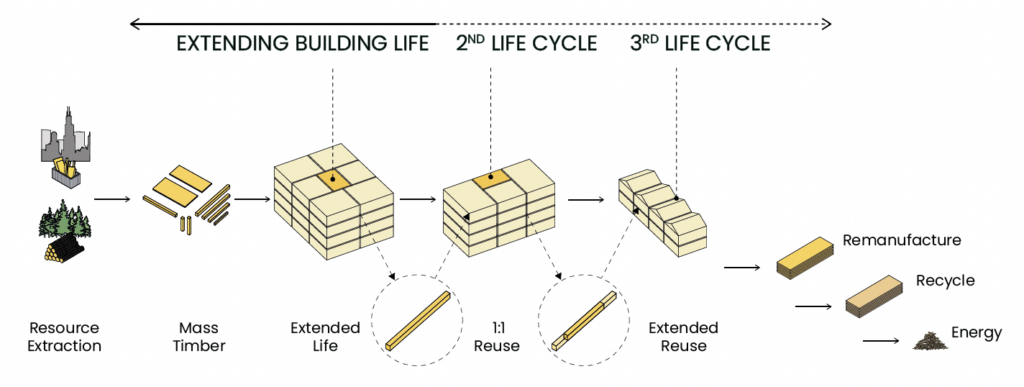

The construction industry is transitioning from a linear takemake- dispose model to a circular economy, driven by emerging legislation and growing requirements for material traceability. Buildings are increasingly viewed as long-term material assets, supported by digital passports that enable future reuse.
Circularity is about more than designing buildings that can be disassembled. The greatest environmental and commercial benefits come from extending a building’s life, preserving embodied carbon and retaining the value of materials. Early design decisions determine whether a building remains adaptable over time or becomes premature demolition waste.
Working with the wider WOODCIRCLES consortium, Waugh Thistleton Architects has developed a timber building system that embeds circularity from first principles through to construction detailing. The system prioritises durability, repair, adaptability and material reuse, enabling buildings to evolve over time while preserving the value of their materials.
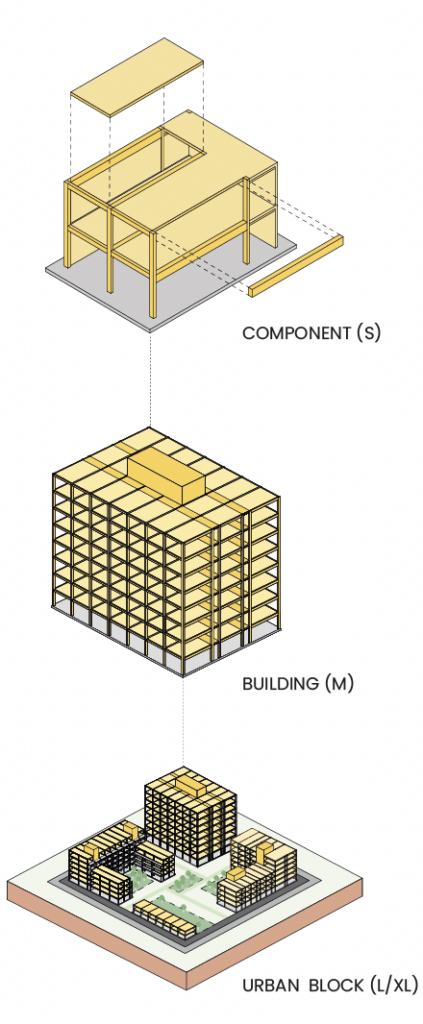
Components are designed with standardised interfaces, reversible connections and digital material information to support future recovery and reuse. Together, these features create long-term value for asset owners while helping remove barriers to harvesting and reusing timber from the urban forest.
The technologies needed to deliver circular timber buildings already exist. Embedding these principles from the outset is both technically achievable and commercially viable, enabling buildings to become adaptable, low carbon material banks that retain value across multiple life cycles.